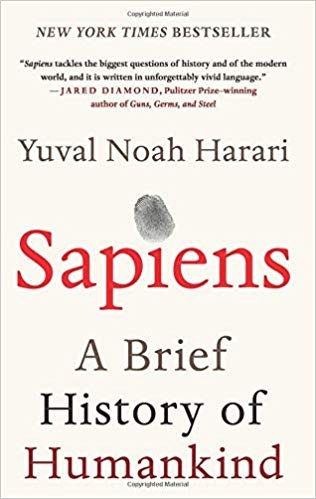
Sapiens
A Brief History of Humankind
by Yuval Noah Harari
Editorial review
Harari's audacious one-volume history of our species is among the most discussed nonfiction books of the last decade. Some specialists quibble with details; the framework — that shared fictions, not biology, made us dominant — has reshaped how a generation talks about the human story.
AI-distilled summary
Israeli historian Yuval Noah Harari traces 70,000 years of human history from the cognitive revolution through the agricultural and scientific revolutions, arguing that what truly distinguishes Homo sapiens is the ability to coordinate at scale around shared imagined orders — gods, nations, money, and corporations.
Key takeaways
- 1
Most large-scale cooperation rests on shared fictions, not on objective reality.
- 2
The agricultural revolution was a trap as much as a triumph — for the species, not the individual.
- 3
Money, empire, and religion are the three great unifiers of humankind.
- 4
Happiness research suggests modern life is not obviously better than ancestral life.
The right reader
Anyone who wants a single, ambitious frame for human history. Especially valuable as a first 'big history' book.
What it touches
How it reads
Sweeping, provocative, narrative.
Reading difficulty: Accessible


